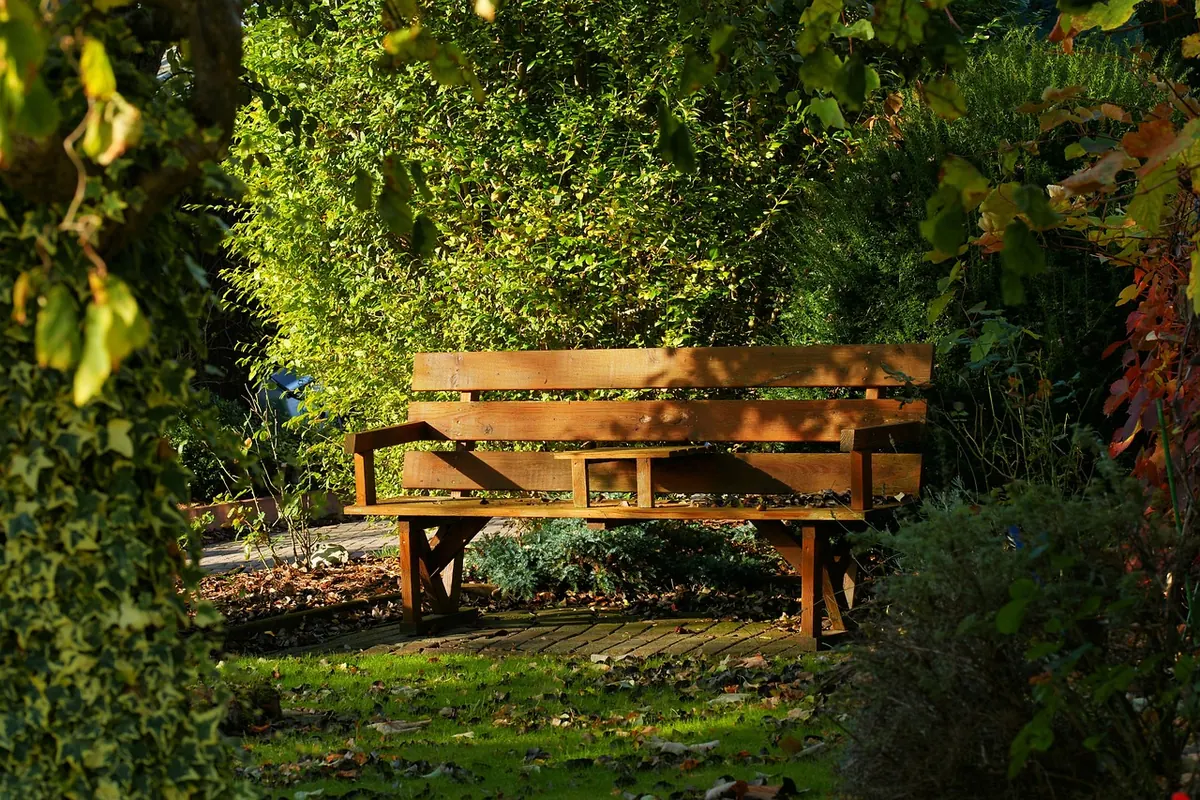
The most common mistake with a new garden bench is not the timber, the style or the colour. It is the size. A bench that looks modest in a showroom or on a screen can arrive and swallow half the patio, or leave a gap so tight that you sidestep past it with a mug of tea in one hand. Ten minutes with a tape measure before you order saves all of that. Here is how to work out what your space will genuinely take.
Measure the length of the wall, fence or border where the bench will sit. Then walk along that line and note everything else sharing it: a downpipe, an outdoor tap, a shed door, a shrub you would rather not flatten, a step down to the lawn. Subtract those and write the usable figure down. A 4 m fence run with a shed door at one end, for example, leaves you roughly 2.8 m of clear ground.
Then measure depth, which is the number people forget. Take the tape from the wall or fence outwards to the first thing in the way — a lawn edge, a planting bed, a path, a table. That figure decides whether a bench around 60 cm deep still leaves you room to walk in front of it.
Finally, look at the surface. Paving and decking give you a level base straight away. Grass dips and softens, so the feet of a heavy bench will sink unless you set it on slabs or a flat spot. Sloping ground usually means finding the flattest available patch rather than hoping for the best.
Bench sizes vary by maker, but most garden benches sit within a fairly narrow band. Knowing the figures in advance means you can rule options in or out before you fall for one.
Measure the seat, not the frame. Plenty of benches flare outwards at the base or have legs that sit wider than the slats above them.
Clearance is where a bench either works or quietly annoys you for years. Three figures cover most situations.
Put those together with a real example. A patio 2.4 m wide with a 60 cm deep bench against the house wall leaves 1.8 m of walking space — comfortable. Push the same bench into both ends of that width and you are down to 1.2 m down the middle, which sounds fine until two chairs are pulled out and someone is trying to get past with a watering can.
A two-seater suits small courtyards, narrow borders and corners where a larger bench would feel like a barrier. A three-seater is better for family use, but at 1.7 m it will dominate a compact patio and leave little room for pots or a side table.
If you like to read with your legs up, look for a deeper seat or a lounger-style back rather than a wider one. If the bench will sit with a small table, measure the table first: allow roughly 70–75 cm between the front edge of the seat and the table edge so you can get in and out without clambering.
Sun direction matters as much as millimetres. An east-facing bench catches morning light and is warm by nine o'clock; a west-facing one holds the evening. The bench that fits the shadiest corner perfectly is often the bench nobody sits on.
Before you commit to a length, walk the route the bench will take to get there. Measure the gate posts inside to inside, the doorway of the shed or side return, and the tightest bend on the path. A 1.6 m bench can usually be carried on its side through a 90 cm gap, but a 2 m path corner turned flat is another matter. Flat-packed benches that you assemble on the spot are far easier to manoeuvre.
Weight deserves a thought too. Cast iron and stone benches are heavy enough to need a firm, level base and two people to shift; teak and lighter metal frames can be moved by one person when you want to cut the grass underneath. For anything substantial, check the ground will take it before the delivery van arrives.
You do not need the bench to test the position. Lay a tape measure on the ground and mark the corners with bamboo canes or lengths of string. Then sit in the middle of it on a dining chair for five minutes — same seat height, roughly the same posture — and look around.
Ask yourself a few blunt questions. Is the view worth it? Is the tap or the drain behind your shoulder? Does the washing line cross above your head? Can someone walk past you without turning sideways? Would moving the whole thing 60 cm along the wall solve a problem? Small shifts change a space more than you expect.
Write these seven numbers on a scrap of paper and take them with you, whether you are browsing online or standing in a garden centre.
Any bench that fits inside every one of those numbers will settle into the garden rather than fight it. Buy to the smaller figure rather than the larger one: a bench with a little breathing room around it invites you to sit down, while a tight one always feels like an obstacle.
Photo: Kapa65 / Pixabay
A practical guide to digging, edging and compacting a durable gravel path and seating pad around a garden bench,...
Practical ways to cut the workload in a small British garden, from gravel and raised beds to evergreen structure,...

Yellow leaves, soggy compost and straggly growth usually trace back to a handful of container-care mistakes. Here's...

Gardening wisdom for your outdoor space..
